
CTV advertising is no longer just for big brands
Small and medium-sized businesses have largely remained outside this ecosystem, until now.
August 27, 2026
By Pavlo Klymenko
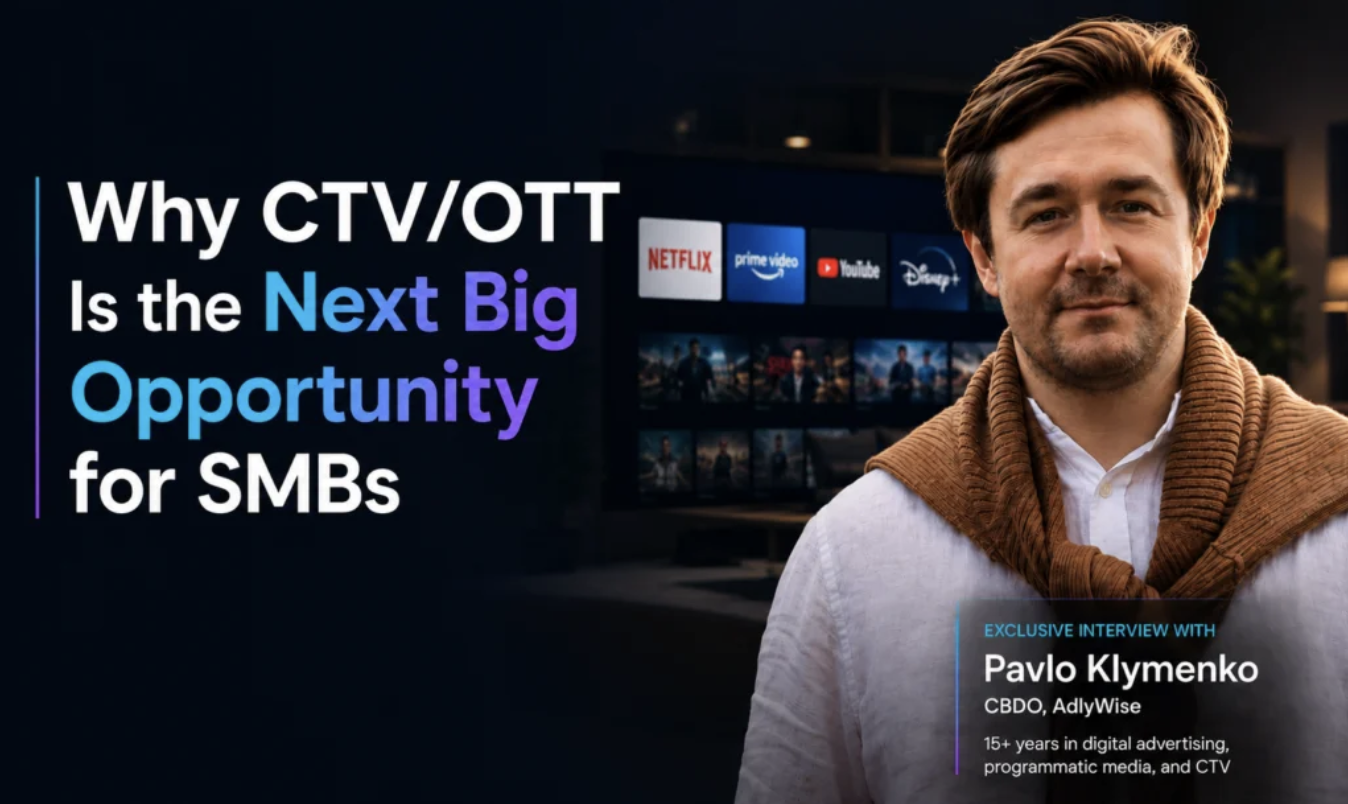
For years, advertising on television has been associated with large brands, national campaigns, expensive production and media plans that require six-figure budgets.
Small and medium-sized businesses have largely remained outside this ecosystem.
This is a serious gap. Small businesses account for approximately 98.2% of all employer businesses in Canada, yet most local companies still rely primarily on search, social media and traditional display advertising to reach customers.
At the same time, the way Canadians consume television has fundamentally changed. According to data referenced by the CRTC, 76% of Canadian adults own a connected TV. Television is increasingly delivered through smart TVs, streaming applications, FAST channels and internet-connected devices rather than only through traditional cable packages.
The audience has moved. The technology is available. The advertising infrastructure exists.
But for many SMBs, buying Connected TV advertising is still unnecessarily complicated.
Why smaller advertisers have struggled to enter CTV
When we started speaking with smaller advertisers, local businesses and performance marketing teams, we consistently heard the same concerns.
They were interested in appearing on television screens, but they did not know where to start.
CTV buying often involved unfamiliar terminology, multiple technology providers, agency retainers, minimum commitments, complicated media plans and limited visibility into where the budget was going.
A business owner who can launch a Meta campaign in 20 minutes may suddenly be asked to understand DSPs, SSPs, VAST tags, supply paths, frequency caps, inventory quality and attribution models.
That is not a problem with the advertising channel. It is a problem with the way access to the channel has traditionally been designed.
The market data confirms that demand is moving toward digital video. Canada’s digital advertising market reached approximately CAD 21.1 billion in 2025, growing 16% year over year. Video was one of the fastest-growing categories, increasing by 26%, partly because advertisers continued shifting budgets toward Connected TV and premium streaming environments.
In the United States, digital video was expected to capture nearly 60% of all TV and video advertising spend in 2025, compared with only 29% in 2020. CTV advertising itself grew 16% year over year in 2024.
CTV is clearly becoming a mainstream advertising channel. However, mainstream adoption will not be complete until smaller advertisers can use it without needing an entire programmatic advertising department.
We built the familiar Meta experience — but for CTV
At AdlyWise, our goal is to make launching a Connected TV campaign feel familiar to anyone who has previously used Meta Ads Manager or another self-service advertising platform.
The basic process should be understandable:
- Select the campaign objective.
- Define the geography.
- Choose or build the audience.
- Set the budget and campaign dates.
- Upload the video creative.
- Launch the campaign.
- Review performance and optimize.
Behind this relatively simple workflow is a complicated advertising infrastructure. But the advertiser should not have to manage that complexity manually.
A restaurant owner should be able to target households within a relevant area.
A real estate developer should be able to reach potential homebuyers in selected postal codes.
A local dealership should be able to show different campaigns to different cities.
An e-commerce company should be able to combine CTV prospecting with retargeting and performance measurement.
A B2B company should be able to reach relevant professional or business audiences without purchasing a national television campaign.
The interface should speak the language of the advertiser, not the language of advertising technology.
Building audiences without becoming a data scientist
Audience creation is one of the most challenging parts of programmatic advertising.
Traditional platforms often present advertisers with hundreds of categories and technical filters. Smaller advertisers may not know which segments to select or how different targeting criteria affect campaign reach.
AdlyWise uses AI-assisted audience building to simplify this process.
Instead of starting with an overwhelming list of technical categories, an advertiser can begin by describing the customer they want to reach.
For example:
Homeowners aged 30–55 in the Greater Toronto Area who may be interested in renovations, interior design and premium home products.
The platform can then help translate that business description into a practical audience strategy.
The advertiser still controls the geography, budget and targeting logic, but the starting point is a description of the actual customer rather than a complicated data taxonomy.
This is particularly important for SMBs because they rarely have dedicated media planning, programmatic buying and data analytics teams. Their advertising tools need to reduce operational work rather than create more of it.
CTV does not require a national television budget
One of the biggest misconceptions is that advertising on television always requires an enormous budget.
Connected TV campaigns can be limited by geography, audience, campaign duration, frequency and total spend.
Consider a simplified example.
At an illustrative CPM of CAD 30, a CAD 3,000 media budget would represent approximately 100,000 ad impressions. The real CPM and delivery will vary depending on the audience, inventory, geography, campaign settings and market conditions, but the example demonstrates an important point: a business does not need to purchase nationwide television coverage to test CTV.
It can start with one market, one audience, one creative and one measurable objective.
A smaller initial campaign can answer practical questions:
- Does CTV increase branded search activity?
- Are more people visiting the website after seeing the campaign?
- Which geography produces the strongest response?
- How does performance change when the creative changes?
- What frequency produces sufficient awareness without excessive repetition?
- Can CTV improve the performance of search, social and retargeting campaigns?
This is how SMBs already approach other digital channels: start with a controlled test, collect data and scale what works.
CTV should be purchased in the same way.
CTV should connect brand advertising with measurable outcomes
Television has traditionally been treated as an awareness channel, while search and social media have been treated as measurable performance channels.
Connected TV can help bring these two worlds closer together.
The television screen provides a high-impact, full-screen video environment. Programmatic technology adds audience targeting, budget controls, frequency management and campaign reporting.
Depending on the advertiser’s setup, measurement can include:
- Impressions and unique reach
- Video completion rate
- Cost per completed view
- Audience and geographic delivery
- Frequency
- Website activity
- Retargeting audience growth
- Leads, registrations or purchases
- Campaign-level conversion data
Not every conversion should be attributed to the last click. People rarely click on a television screen in the same way they click on a search advertisement.
A viewer may see an ad on television, search for the company on their phone and complete a purchase later on a laptop.
That means CTV measurement should look at the entire customer journey, including incremental website traffic, branded search, direct visits, conversions and the impact on other advertising channels.
Why this matters now
The industry is already moving in this direction.
According to IAB, a substantial share of new CTV investment is being reallocated from other channels. In 2025, 36% of CTV budget reallocations came from linear television and another 36% came from social media, demonstrating that advertisers increasingly view CTV as both a television channel and a digital advertising alternative.
Self-service technology is an important part of this shift. IAB specifically identified accessible pricing, programmatic tools and the ability to connect advertising spend with business outcomes as factors bringing more small and mid-sized advertisers into CTV.
For SMBs, this is not simply an opportunity to run a television commercial.
It is an opportunity to combine the emotional impact of television with the flexibility of digital advertising.
Making television accessible to every serious advertiser
Our vision at AdlyWise is straightforward: access to premium video advertising should not depend on the size of an advertiser’s marketing department.
SMBs should be able to launch CTV campaigns with the same confidence with which they launch campaigns on Meta or Google.
They should be able to understand what they are buying, control how much they spend, define who they want to reach and see how the campaign contributes to their business goals.
The future of television advertising will not consist of only a few hundred global brands purchasing large national campaigns.
It will include thousands of restaurants, dealerships, professional services companies, retailers, technology businesses, real estate companies and local brands reaching the right audiences in the right markets.
CTV does not need to become simpler as an advertising technology.
It needs to become simpler for the advertiser.
That is what we are building at AdlyWise.
Paul Klymenko
CBDO, AdlyWise




Ready to Get Involved?
Join a local hub, attend an event, or just stay in the loop. There's a place for every marketer in this community.